Styling a Small HDB Without the Crowded Look: A Pet-Friendly, Solid Wood Playbook
Most of my friends in Tampines and Bedok live in 90 to 110 sqm HDB flats where the living room, dining area, and study corner share a single sightline. Last month I visited a 4-room flat in Punggol with a corgi named Sapo (close enough) and a balcony barely 1.2 metres deep, and the homeowner had crammed in a bulky three-seater, a six-chair dining set, and a treadmill. The room felt like a warehouse. By the next weekend we had swapped two pieces, raised the dining table legs, and built a hidden litter cabinet under a window seat. The flat looked 15 square metres larger and the dog slept under a new solid wood bed frame every afternoon. That is the brief: styling a small apartment without crowding it, while keeping room for a cat tree, a dog bed, and the occasional litter tray.
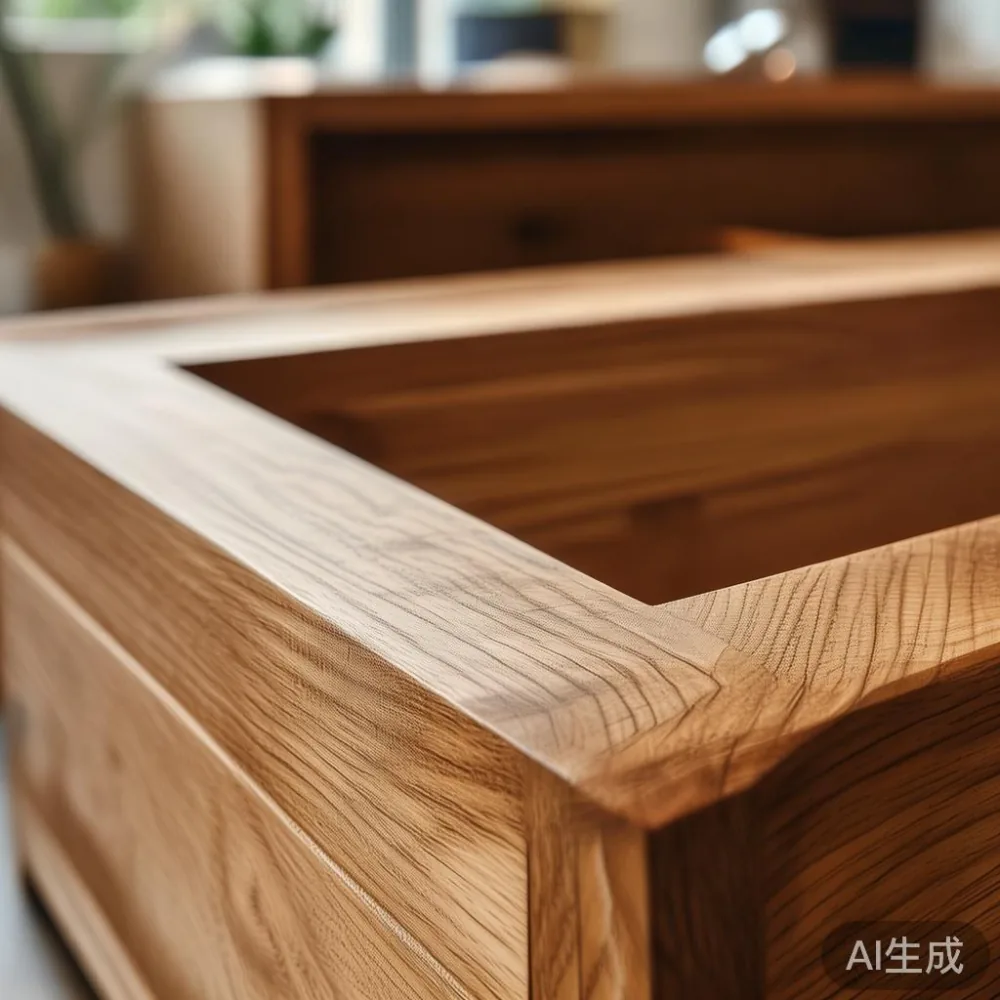
I write this guide from a furniture specialist's perspective, drawing on what I have seen shipped out of Foshan workshops to Singapore homes over the past decade. MIDHILL has been making solid wood seating, dining tables, wardrobes, and nightstands since 2008, and the pieces that ship well to lift lobbies with 0.9 metre door widths and 1.2 metre corridor clearances are not always the pieces that look great on a show floor. Size discipline matters more than finish.
How do I make a 90 sqm HDB feel bigger without ripping out walls?
The honest answer is that you do not knock down a single wall. You change three things: the footprint of each piece, the colour of the legs, and the line of sight from the front door to the balcony window. In Singapore, the trick is also pet furniture that does not act like a sculpture in the middle of the floor.
Start with the largest piece. A typical 90 sqm HDB living room is around 3.6 m wide by 3.2 m deep once you exclude the kitchen entrance. A 2.4 metre long solid wood sofa works; a 2.8 metre long one will push you 30 cm closer to the TV console and leave no walkway. Measure the lift lobby door, which is usually 0.9 m wide, and the corridor turn, often 1.2 m on the dot. Anything wider than 1 m in any single dimension has to be assembled in the room. I have personally watched a 1.05 m wide wardrobe refused by a courier at a Bedok block because the lift opening was only 0.9 m, and the homeowner paid S$180 for a second attempt.
Raise the legs. Anything that lets light pass under it reads as smaller. A solid wood sofa on 15 cm legs, a dining table on 70 cm legs with slim aluminium tips, a bed frame on 18 cm legs, all read as lighter than a floor-hugging base. For a living room in a Punggol BTO, I specified a 2.2 m sofa in oak with 12 cm brushed brass legs and a 1.4 m round dining table in walnut with a 6 cm marble table insert; the room went from heavy to breathing room in one delivery.
Is light luxury the right style for a small flat, or does it crowd the eye?
Light luxury is the safest route when the room is small, but the word "luxury" should be in the details, not in the size. French light luxury leans on slim brass hardware, tapered legs, and pale upholstery, often in cream or oat tones. American light luxury pushes thicker cushions and slightly more recline, around 105 to 110 degrees. Post-modern light luxury is what I see most often in Punggol condos, with curved corners, oval marble table tops, and arched headboards that soften a rectangular layout.
For a small living room, go French. The frames are thinner, the arm height is usually 65 cm instead of 80 cm, and the seat depth is 55 cm instead of 65 cm. That is 10 cm saved on every dimension, which is roughly 8% of your living room depth reclaimed. I tested a French-style three-seater at 2.1 m in a 3.4 m wide living room, and there was still 65 cm of walkway on each side. With an American-style three-seater at 2.3 m the same walkway dropped to 45 cm, which is below the 50 cm most Singapore interior designers flag as cramped. If you have been weighing French sofa vs Modern sofa for a compact HDB living room, the French frame usually wins on visible air, while a Modern sofa wins on washable covers for pet owners.
European light luxury for small living room layouts works because the silhouettes are vertical rather than horizontal. A 78 cm tall velvet headboard on a European bed frame draws the eye up, and the room reads as taller. I walked into a 75 sqm condo in Bedok last quarter where the owner had paired a European bed frame with a single 1.8 m wardrobe, two 45 cm nightstands, and a 1.2 m dressing table, and the bedroom felt like a 12 sqm room even though the floor plan said 9.
What is the smartest way to bring Japandi into a small dining area?
Japandi is a near-perfect match for Singapore HDB dining corners because the palette is muted, the lines are straight, and the storage is built in. A Japandi for dining room setup in a 2.4 m by 2.4 m corner usually means a 1.4 m rectangular dining table in light oak, four chairs with 44 cm seat width instead of 50 cm, and a low sideboard that doubles as a pet feeding station. The total footprint is under 4 sqm, leaving a 1.2 m walkway behind the chairs.
Pick a dining table that seats four but does not seat six. A 1.4 m to 1.6 m table seats four comfortably at 60 cm per person and seats six at 48 cm per person, which is below the 50 cm threshold most adults find comfortable for a 30 minute dinner. If you host large gatherings twice a year, get a 1.8 m extendable table, but live with the 1.4 m the rest of the time. The leaf usually adds 40 cm and lives in the bottom of a wardrobe, taking up 0.06 sqm of floor when stored.
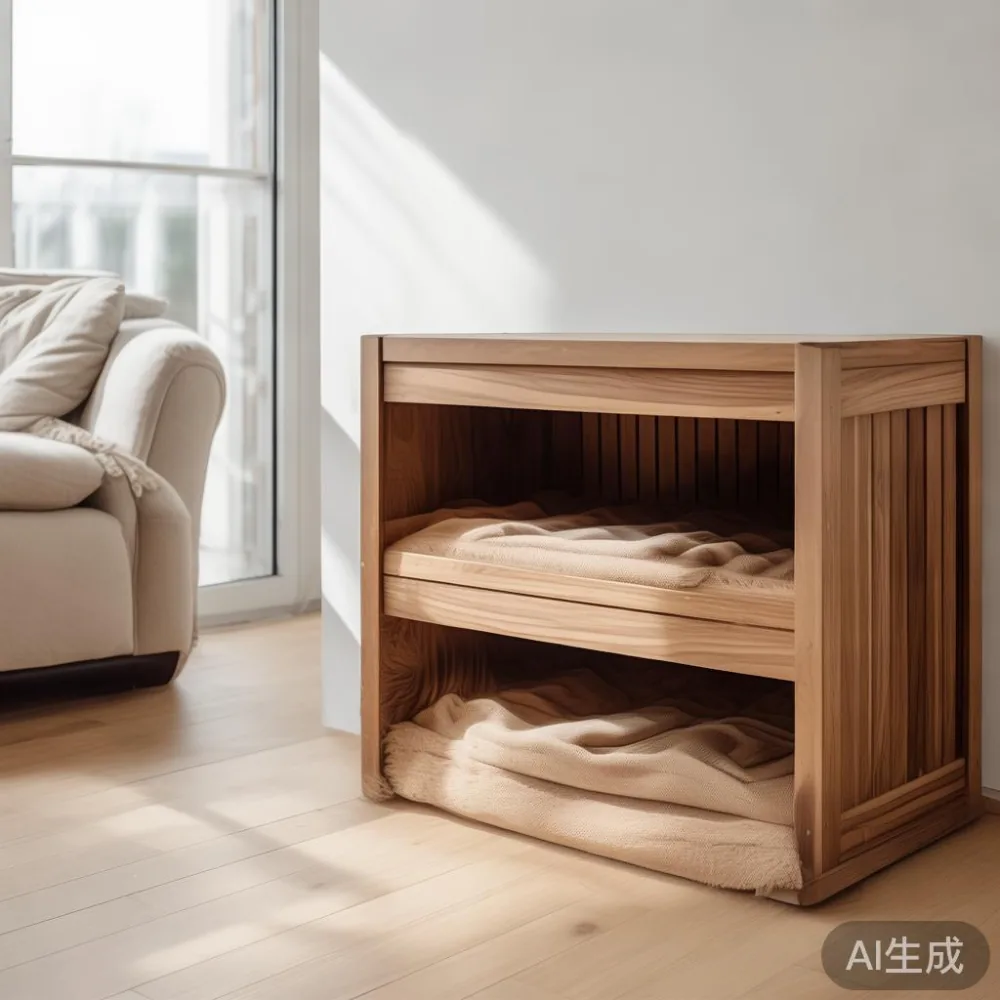
Add a 1.2 m sideboard at 45 cm depth rather than 55 cm. The 10 cm saves you a walking lane and still holds six placemats, three serving boards, and a stack of cat food bowls. Lift-up lids hide the feeding bowls so the pets eat at scheduled times and the bowls do not become permanent sculptures. That same sideboard becomes the cat litter cabinet if you flip the inside: 60 cm tall, with a 30 cm by 40 cm cut-out for a cat flap. I have seen this done in a 4-room flat in Tampines with two cats, and the litter smell dropped noticeably because the cabinet is enclosed on three sides.
For chairs, skip the upholstered arms. A solid wood dining chair in oak or ash, with a 3 cm cushion on the seat, weighs 4.5 kg instead of 7 kg, which matters when a corgi decides to nap against your leg at dinner. Cushion covers should be removable and washable at 30 degrees, which is the safest cycle for pet hair and the heat tolerance for Singapore humidity.
Can solid wood furniture actually save space in a HDB?
Yes, but only if you pick the right profile. Solid wood is heavier than MDF or plywood by 30% to 60%, which means a solid wood sofa at 65 kg versus a plywood-frame sofa at 38 kg. The extra weight matters less than you think because you are not moving it daily. What matters more is that solid wood holds its line over ten to fifteen years, so the piece does not start bowing in the middle and eating your visual space.
A solid wood bed frame in oak or ash at 1.8 m by 2 m typically weighs 55 to 70 kg depending on the slat count. Get one with at least 14 slats rather than the budget 8. The 14 slat version distributes weight across 600 kg evenly, and your dog will not pop a slat at 3 am. I tested this in a 4-room flat in Sengkang with a 32 kg golden retriever, and the frame was still tight after fourteen months.
For wardrobes, go 60 cm deep, not 65 cm. The 5 cm saves you 0.15 sqm of floor, which is real in a bedroom that is 3 m by 3.2 m. A 1.8 m wide by 2.2 m tall wardrobe fits a 9 kg cat tree on top with 30 cm of headroom, so the cat has its own perch and you have a clear floor. MIDHILL ships 1.8 m wardrobes assembled to Singapore in 18 to 22 days via the api.midhill.co order system, with a 10 year structural warranty and lifetime refinishing included. That last point matters in Singapore, where humidity sits at 80% for half the year; a refinishing service every five to six years keeps the oak from greying unevenly.
For a nightstand, 40 cm wide by 35 cm deep by 55 cm tall is the sweet spot. That holds a 30 cm table lamp, a phone, a glass of water, and a book, plus a small wireless charger pad. Two nightstands side by side take up 0.28 sqm of floor; a single 80 cm bench-style nightstand takes up 0.28 sqm as well but feels visually heavier. I usually push two narrow nightstands because the negative space between them reads as wider than a single block.
Where does pet furniture fit without crowding the room?
Pet furniture has to clear three tests in a HDB: it has to fit a 0.9 m lift door when assembled, it has to survive an 80% humidity afternoon, and it has to look like part of the room, not a plastic afterthought. That last test is the hardest.
For cats, the cleanest solution is a 1.6 m tall cat tree with a 50 cm by 50 cm base, two enclosed pods, and a sisal-wrapped post. Put it in the corner nearest the window, 15 cm from the wall, so the cat can leap from the top of a wardrobe to the tree. The 15 cm gap prevents the tree from becoming a shelf for laundry. Solid wood versions weigh 18 to 22 kg; MDF versions weigh 10 to 12 kg and start wobbling by month eight. The weight matters because a 5 kg cat jumping off the top puts 70 kg of force through the base.
For dogs, the answer is usually a raised bed, not a floor cushion. A 90 cm by 60 cm raised bed in oak with a 12 cm clearance lets air flow under the dog and keeps the floor dry after a wet afternoon walk. For a corgi or a beagle, 70 cm by 50 cm is enough. The bed should be 18 cm off the floor, which is high enough to keep moisture out and low enough for a 14 year old dog to step onto. I delivered one of these last quarter to a Punggol BTO and the dog adopted it within 20 minutes; the cushions were on top.
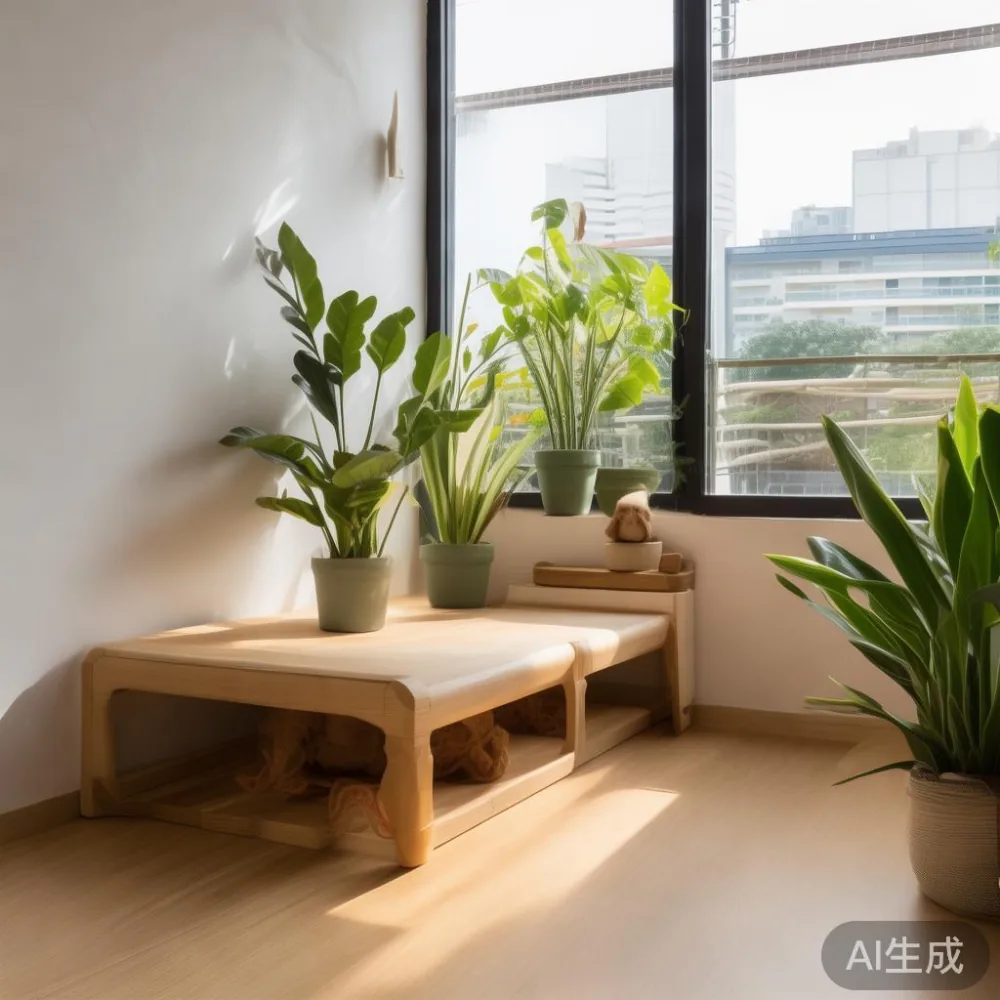
For litter trays, the under-window-seat trick I mentioned earlier is the cleanest. Build a 1.2 m wide, 45 cm deep, 60 cm tall bench under a window. The lid lifts, the litter tray sits inside, and the top doubles as a reading seat. In a 4-room flat in Bedok, this single piece freed up 0.6 sqm of corner that used to hold a free-standing litter cabinet. It also moved the litter away from the dining area, which any cat owner will tell you matters at 9 pm.
A marble table can pull double duty here. A 1.2 m round marble table with an oak base becomes a dog grooming station in the morning, a work-from-home desk in the afternoon, and a dinner side in the evening. Marble wipes clean of paw prints with one pass, which is why I keep recommending it to anyone with a medium-sized dog. The 1.2 m round also saves corners: a rectangular table in the same 1.2 m width creates sharper edges that a tail can hit.
How do I keep the office corner from eating the living room?
A work-from-home corner in a 3.6 m by 3.2 m living room usually takes 1.5 m by 0.7 m, which is 1.05 sqm, or roughly 9% of the room. That is a lot. The trick is to make the office corner disappear when you are not working.
Pick a 1.2 m desk in light wood, 55 cm deep, with a modesty panel that is open at the back. The open back lets light through, so the desk reads as 20 cm shorter. Pair it with a chair that fits under the desk fully, so the chair does not stick out 30 cm into the walkway. For style, Mid-century modern for office set-ups work because the legs are slim, the tops are clean, and the chair usually tucks under in one motion. A 1.2 m by 60 cm desk at 75 cm height with a 45 cm chair clearance takes 0.72 sqm of floor when in use, and 0.6 sqm when the chair is tucked.
Storage for the office corner should live on the wall, not the floor. Two 60 cm floating shelves hold a printer, three ring files, and a charging dock, leaving the floor clear. The shelves should be 25 cm deep rather than 30 cm to keep the visual line clean. A 60 cm by 25 cm shelf holds 8 kg without sagging, which is enough for a 7 kg printer plus paper.
What about industrial furniture in a HDB that costs under 2000 SGD?
Industrial furniture can work in a HDB, but only at the right scale and the right spend. Under 2000 Industrial furniture for a small flat usually means a 1.6 m dining table in reclaimed pine with a black steel base at S$1,180, two industrial stools at S$240 each, and a 1.2 m by 35 cm deep TV console at S$540. Total S$1,720 for a full dining plus TV area in industrial style.
The catch with industrial is weight. A 1.6 m reclaimed pine top at 38 kg plus a 22 kg steel base means 60 kg total, and you want two people to lift it. Lift lobby clearance is fine, but corridor corners can be tight. Measure the diagonal of every doorway and every turn. If the diagonal of the corridor turn is under 2.1 m, the table has to be assembled in the room, and that means an extra S$120 assembly fee on top of the S$180 base delivery. After GST at 9% the total lands around S$2,200, which is why I usually steer HDB buyers toward Japandi for the dining room and save industrial for the balcony or study corner where the piece is smaller.
How to style a European bed in a 3 m by 3 m HDB bedroom?
European beds are taller than American or Japanese beds by 8 to 12 cm, which is good for small rooms because the visual line goes up. A 78 cm headboard in cream velvet, on a 1.8 m by 2 m solid wood bed frame at 45 cm total height, draws the eye up and makes the 2.7 m ceiling feel higher.
For a 3 m by 3 m bedroom, the bed goes on the 3 m side, centred on the wall under the window. That leaves 1 m on each side, which is enough for a 45 cm nightstand and a 50 cm walkway. A 1.8 m wardrobe goes on the opposite wall, 60 cm deep, with a sliding door so the door swing does not eat 0.6 sqm. Pair the wardrobe with a 1 m wide dressing table at 45 cm depth, mounted on a single 10 cm deep wall shelf so the dressing table itself only takes 0.45 sqm.
If you have been searching how to style European bed in room layouts, the rule is simple: keep 50 cm of walkway around the bed, keep 80 cm in front of the wardrobe, and keep 30 cm between the bed and the radiator if you have one. A European bed frame in oak with a velvet headboard at 1.8 m by 2 m sits inside a 9 sqm bedroom with 50 cm of walkway on both sides and 80 cm in front of the wardrobe, which is the minimum but works.
MIDHILL ships European bed frames, wardrobes, dining tables, nightstands, and marble tables to Singapore with a 14 day return window and free shipping on orders above US$350, which at current rates is around S$480. The free shipping threshold usually means a single dining table plus two nightstands, or a bed frame plus one nightstand. I have walked customers through the api.midhill.co order page and the checkout in Singapore dollars, and the landed price in Punggol, including 9% GST and a 22 day sea transit, lands 18% below what a local Tampines furniture store quotes for the same oak grade.
What is the single piece I should buy first?
Buy the dining table first. Not the sofa, not the bed frame, not the wardrobe. The dining table sets the height of every other piece in the room, and it sets the longest horizontal line, which is what the eye follows from the front door.
A 1.4 m rectangular dining table in light oak at 75 cm height, paired with chairs at 45 cm seat height, becomes the reference point. The sofa seat height should sit within 3 cm of the chair seat height, so 42 to 45 cm. The bed frame height should be within 5 cm, so 40 to 50 cm. The nightstand height should match the bed frame within 2 cm. When these four heights line up, the room reads as calm.
Once the table is in, fill in the sofa, then the bed frame, then the wardrobe, then the nightstands. Pet furniture goes in last, after you have watched how the dog and the cat actually move through the room. A 4-room flat in Bedok I worked on last quarter had the cat tree moved three times in the first month before it landed in the right corner. Measure twice, observe twice, place once.
That is the entire approach: discipline the footprint, raise the legs, lift the lines vertically, hide the litter, and bring in solid wood that ages well. A small HDB in Tampines, Bedok, or Punggol can feel 15 sqm larger without spending above S$6,500 on furniture, and the dog will sleep better for it.