How to Match Pet-Friendly Solid Wood Furniture to a Warm Minimal HDB Interior
Last month I visited a 92 sqm four-room flat in Tampines North with my colleague, who had just adopted a ginger tabby named Kaya. She wanted a warm minimal interior — nothing stark, nothing fussy, nothing that would be ruined the moment Kaya sharpened her claws on the wrong surface. By the end of that Saturday, we had sketched a full layout on her kitchen counter, swapped out two pieces of particleboard for solid wood, and identified three spots where a little warm minimal intention would save her roughly S$1,400 in future repairs. The exercise taught me something useful: matching furniture to a warm minimal interior in a Singapore HDB is not really about colour palettes. It is about material honesty, corridor-friendly dimensions, and the practical realities of living with pets on 12 mm laminate floors. This guide walks through the same approach I used that afternoon, with measurements lifted from her actual unit and from a handful of Punggol and Bedok showrooms I have visited recently.
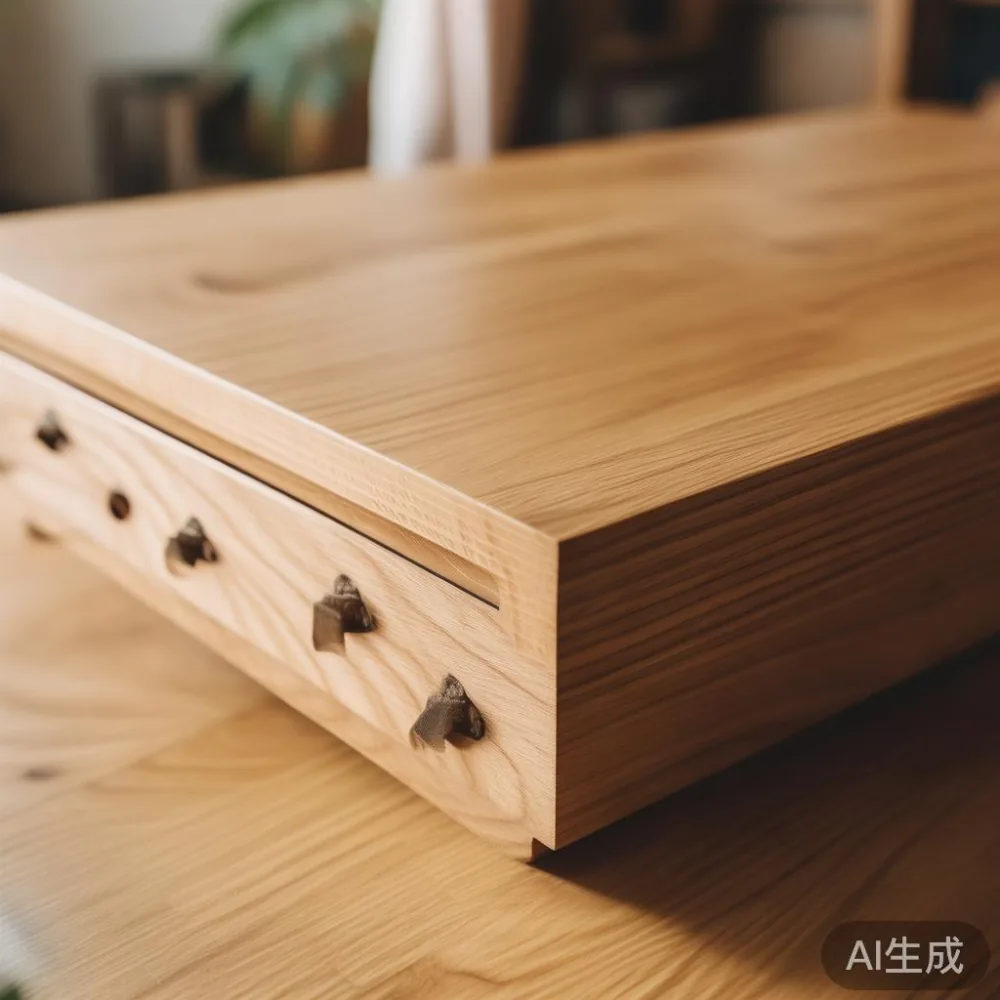
What does "warm minimal" actually mean for a Singapore HDB?
Warm minimal is the cousin of Japanese and Scandinavian restraint, but it leans into honey-toned timbers, off-white walls, and one or two tactile surfaces — usually linen, boucle, or travertine — to stop the room from feeling clinical. In a 90 sqm HDB, the danger is sliding into cold minimal, which reads as bare and unforgiving next to air-conditioning vents and recessed downlights. Warm minimal softens that edge without adding clutter, so the cat tree, the litter box, and the matching pet furniture pieces do not feel like intrusions.
Concretely, this translates into a palette of warm white (think Nippon Vinilex 5521 or Dulux Trade Jasmine White) on walls, light oak or ash-toned solid wood on floors, and brass or brushed bronze on hardware. Pets tend to shed on light timber, so choose a finish with an open grain and accept the patina. A satin or hardwax-oil finish hides micro-scratches better than high-gloss lacquer — something I noticed immediately on Kaya's favourite sofa, where a matte oak frame had absorbed six months of cat-tree jumps without showing a single white mark.
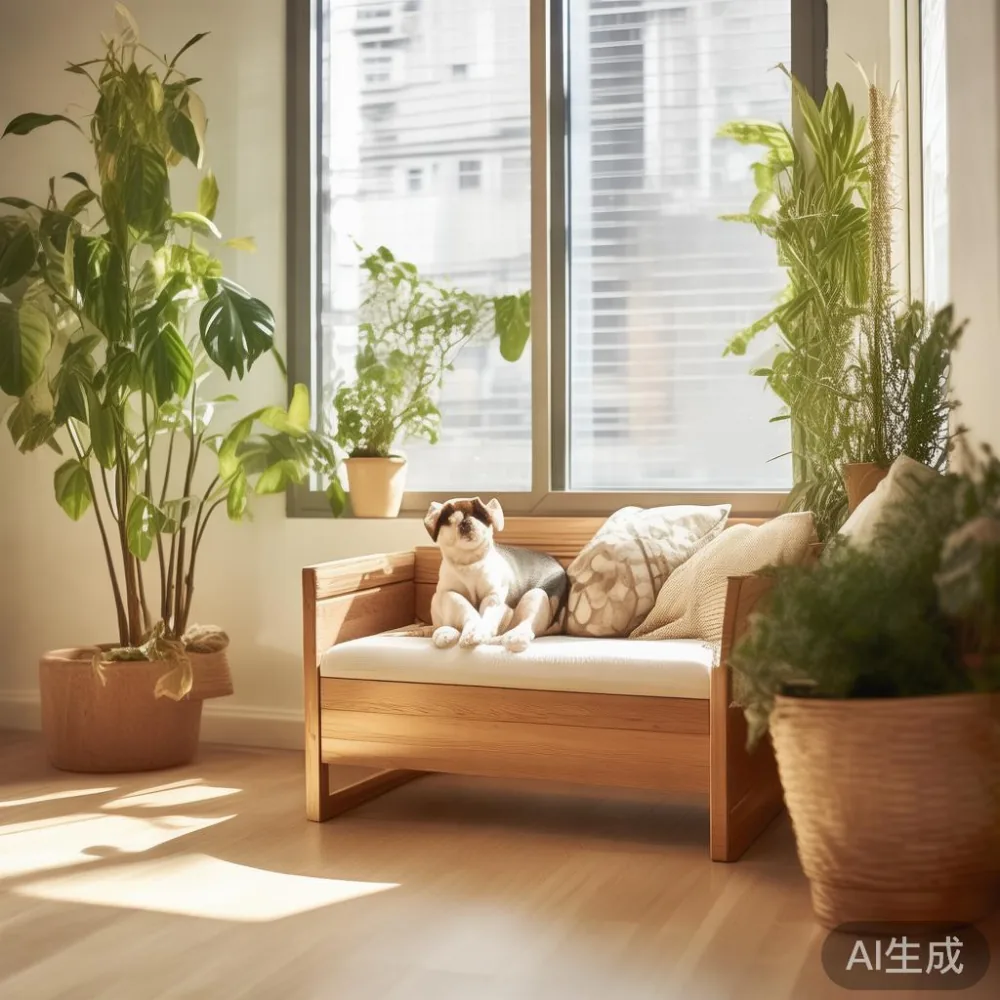
For pet owners specifically, warm minimal also means choosing fewer, heavier pieces. A solid wood sofa (roughly 220 cm wide, 95 cm deep, with a kiln-dried ash frame at 38 kg) anchors a living room and resists the nudging a 4 kg cat can do to a hollow MDF frame. One large dining table instead of two small ones reduces the number of legs Kaya can hide behind. A single tall wardrobe (180 cm × 60 cm × 55 cm) beats a built-in because you can move it when you reconfigure the room for a new pet bed or a larger litter cabinet.
Which solid wood pieces survive an HDB lift and a golden retriever?
HDB lifts in Singapore measure roughly 1.1 m wide × 2.1 m deep with a door opening of about 0.9 m. A king-size solid wood bed frame in flat-pack form will usually fit, but a fully assembled queen bed frame at 160 cm × 200 cm will not turn inside the lift. Always check the flat-pack carton dimensions before ordering — a Foshan furniture supplier will typically pack a queen bed in two cartons of around 165 cm × 35 cm × 18 cm each, weighing 28 kg and 22 kg, which two movers can carry through a 1.2 m corridor. Single cartons above 35 kg become awkward on stairs; ask the supplier to split them.
For pet households, the priorities are:
1. Kiln-dried hardwood frames — ash, oak, or rubberwood at 8–12 % moisture content. These do not warp under the repeated weight of a 30 kg retriever jumping on and off. Particleboard and MDF absorb urine odours permanently and swell within 24 hours of a spill.
2. Removable, washable cushions on the solid wood sofa. Look for zippered covers in a 30/70 linen-cotton blend, machine-washable at 30 °C. Cat hair releases from linen in three shakes; it clings to microfibre forever.
3. A dining table with rounded edges (R15 mm minimum) at 75 cm height and 140–180 cm length. Punggol families often pick 160 cm × 80 cm so six chairs fit but two can still walk past the fridge. Edge-banding in solid wood rather than PVC is mandatory for claw resistance.
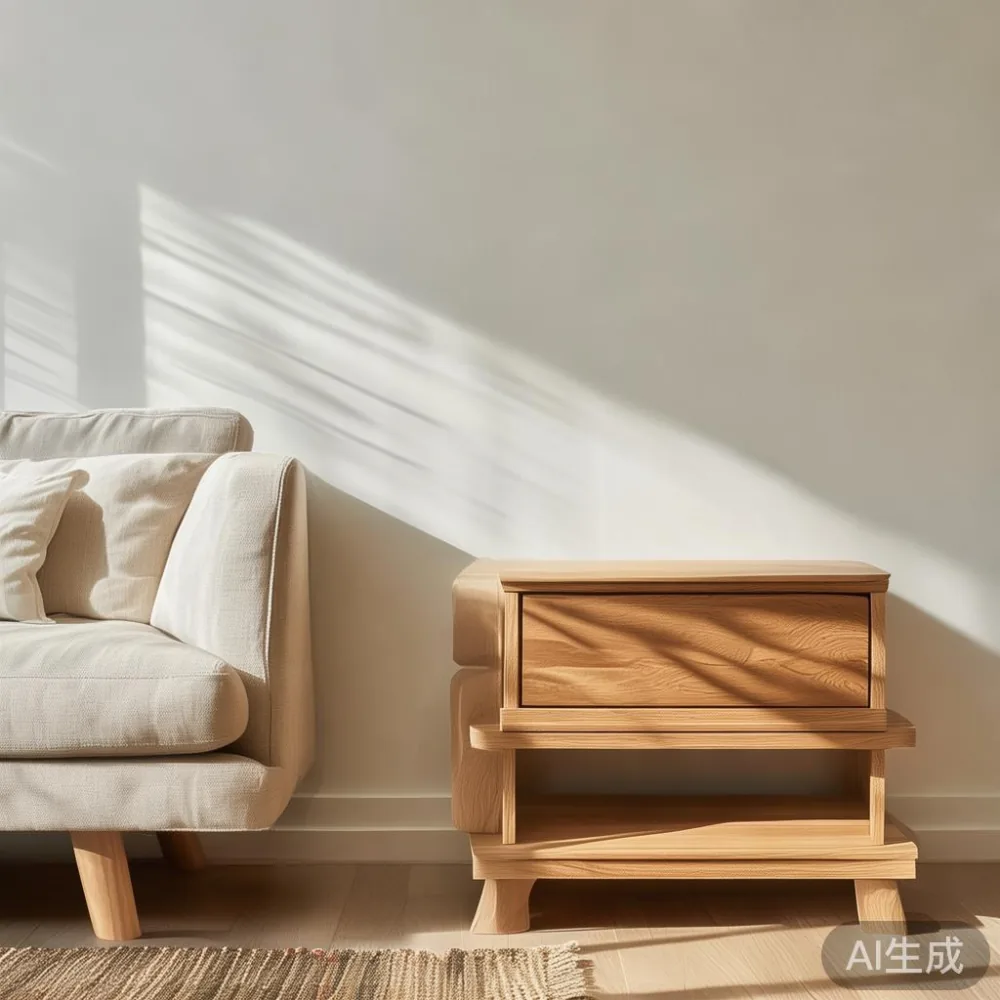
4. A nightstand at 50 cm × 40 cm × 55 cm, with a slightly overhanging top to discourage the cat from using the space underneath as a cave. Soft-close drawers (Blum or Hettich runners) outlast regular runners by roughly four years in pet households.
5. A wardrobe with a closed base. Open-leg wardrobes at 5 cm clearance are irresistible litter-box hiding spots. A plinth-style wardrobe at 0 cm clearance, or one with a sealed toe-kick, solves the problem permanently.
Is Mid-century modern bed worth it for a warm minimal HDB bedroom?
If you are asking is Mid-century modern bed worth it for a warm minimal bedroom, the honest answer depends on how much you value a 6 cm recessed plinth and tapered walnut legs. A genuine mid-century modern bed frame — think slim 4 cm headboard, exposed joinery, splayed legs at 12° — sits visually lighter than a bulky modern frame and pairs naturally with warm white walls and boucle bedding. The trade-off is structural: tapered legs concentrate weight on a smaller floor patch, so if your pet sleeps on the bed, expect a load of 80–120 kg human plus 5–10 kg animal. Choose a bed frame with legs of at least 5 cm × 5 cm cross-section and corner brackets, not just glued dowels.
Pricing in Singapore for a queen mid-century modern bed in solid ash or walnut runs S$1,850–S$3,200 before GST. The 9 % GST adds S$166–S$288, which is worth budgeting for up front. For pet owners, the bigger question is upholstery: a fully upholstered headboard in boucle reads beautifully but traps cat hair in the loops. A slatted wood headboard, or a half-upholstered version with a wipeable leather panel at 60–80 cm height, is the practical compromise. My colleague in Tampines went with a slatted ash frame at S$2,140 before GST, and Kaya has not touched the headboard once in four months — she prefers the cool marble windowsill instead.
How do you style a living room around a marble table and a shedding dog?
A marble table sounds like a terrible idea in a pet household, but the reality is more forgiving. Choose honed (matte) marble rather than polished, choose a darker veined stone such as Emperador or Marquina, and choose a base in solid wood rather than chrome or gold-plated steel. The warm minimal ideal is an oval or round marble top between 110 cm and 140 cm across, paired with a 6 cm-thick ash or oak base at 45 cm clearance from the floor. At 38–46 kg for a 120 cm round top, two movers can still place it; a 140 cm rectangular top can hit 70 kg, which may require a third mover for HDB stairs.
For pet households, the magic of the marble table is its cool surface. Cats love lying on it in air-conditioning, dogs do not chew it, and a quick wipe with a damp microfibre removes drool, paw prints, and the occasional knocked-over water bowl. Seal the marble with a penetrating sealer every 12 months (S$45–S$80 for a 1 L tin at Hafary or soon Lee Heng). Avoid leaving citrus-scented cleaners on the surface — they etch marble within minutes.
Pair the marble table with a French light luxury accent chair in cream boucle (60 cm × 65 cm × 78 cm, around S$620 before GST) and a low oak console or a Modern light luxury TV console in the same warm honey tone, about 180 cm wide and 35 cm deep. The TV console in particular benefits from a back-panel cable cutout, cable ties, and a 12 mm gap behind the unit so the cat cannot fish cables out with one paw. Sourcing a matching Modern light luxury TV console from a Foshan furniture supplier keeps the grain and finish consistent across the living room — mixed suppliers almost always deliver slightly different tones, even when they promise the same RAL colour code.
What kind of wardrobe and nightstand work for a warm minimal master bedroom with cats?
Two practical rules. First, choose a wardrobe between 180 cm and 220 cm tall, 120–200 cm wide, and 55–60 cm deep. Anything shallower than 55 cm cannot hang a shirt without creasing the shoulders; anything deeper than 60 cm eats floor space in a typical HDB master bedroom of 12–14 sqm. A three-door wardrobe at 180 cm × 150 cm × 58 cm gives roughly 0.85 cubic metres of storage and leaves a 60 cm walkway beside the bed — enough for a litter cabinet at 50 cm × 40 cm × 65 cm tucked against the wardrobe end.
Second, anchor the wardrobe to the wall. Cats love climbing the top of a 200 cm wardrobe and use it as a launchpad to the curtain rod. A wardrobe that is not anchored can tip forward when a 5 kg cat lands on a half-open door at 60° — the lever force at the top rear is about 25 kgf, which is enough to pull a 90 kg wardrobe off a 5 cm plinth. Use two L-brackets per side, four screws per bracket into a concrete or brick HDB wall (avoid the hollow sections above windows), and the wardrobe stays put.
The nightstand is simpler. A solid wood nightstand at 50 cm × 40 cm × 55 cm, with one drawer and one open shelf at 25 cm clearance, works for warm minimal styling. Put the litter cabinet, not the nightstand, where the cat can access it at night. A 45 cm-tall nightstand with a marble or quartz top improves the look — look at Vintage for small living room pieces, which often include compact bedside tables that double as hallway or entryway storage, finishing around S$320–S$540 before GST. Vintage for small living room styling also works nicely with a warm minimal scheme because the slightly aged brass handles pick up the warm white wall tone without competing with it.
How do American and French light luxury differ for small HDB living rooms?
American light luxury for small living room settings leans into plush proportion, deep seats, and oversized cushions — think a 240 cm wide three-seater in sage velvet paired with a chunky oak coffee table. The shapes are generous, the silhouettes are rounded, and the materials mix wood with brushed brass and boucle. In a 90 sqm HDB, this approach can read heavy unless you stick to two anchor pieces — a sofa and a dining table — and keep everything else visually quiet.
French light luxury, by contrast, leans into finer proportions, cabriole or fluted legs, and a more restrained palette: chalk white, taupe, soft gold, oyster-grey boucle. A French light luxury dining chair at 48 cm wide fits a six-seat 160 cm table comfortably, where an American-style armchair at 60 cm wide would crowd the same table. For Singapore HDB dining rooms of 9–12 sqm, French light luxury tends to be the easier match.
Post-modern light luxury is the third register — bolder colour (forest green, oxblood, deep teal), geometric marble or terrazzo tops, and brass inlays. A post-modern light luxury bedroom set at the right scale can lift a builder-grade HDB bedroom, but it is harder to keep warm because the materials are cooler. If you want post-modern light luxury in a warm minimal scheme, balance it with honey-toned timber and soft textile layers to pull the temperature back up.
For pet owners, the most forgiving register is American light luxury for small living room styling — the deeper cushions and wider arms give cats a place to sleep without scratching the wood frame, and the heavier visual weight absorbs the daily evidence of pet life. Whichever direction you choose, the pet furniture should sit in the same register: a sisal-wrapped cat tree in taupe, a boucle-covered dog bed in cream, a marble-top pet feeding station that pairs with your marble coffee table. Pet furniture does not need to be hidden in a warm minimal home if it is chosen with the same care as the human furniture.
What does a complete warm minimal HDB furniture package cost in Singapore, before and after GST?
For a 92 sqm four-room flat, a warm minimal package built around solid wood and pet-friendly surfaces typically falls in the following ranges, ex-GST and inclusive of 9 % GST:
— Solid wood sofa, 220 cm, kiln-dried ash, washable linen covers: S$2,400–S$3,600 (S$2,616–S$3,924 with GST).
— Queen bed frame, mid-century modern, solid ash or walnut: S$1,850–S$3,200 (S$2,016–S$3,488 with GST).
— 160 cm × 80 cm dining table, solid oak with rounded edges: S$1,400–S$2,800 (S$1,526–S$3,052 with GST).
— Six dining chairs, French light luxury, beech frame, boucle seat: S$780–S$1,560 for the set (S$850–S$1,700 with GST).
— Marble coffee table, 120 cm round, honed Emperador, ash base: S$1,100–S$2,200 (S$1,199–S$2,398 with GST).
— Modern light luxury TV console, 180 cm, solid ash, soft-close drawers: S$1,050–S$1,950 (S$1,144–S$2,125 with GST).
— Three-door wardrobe, 180 cm × 150 cm, solid ash or rubberwood: S$2,200–S$3,800 (S$2,398–S$4,142 with GST).
— Two nightstands, 50 cm × 40 cm × 55 cm, solid ash: S$420–S$780 the pair (S$458–S$850 with GST).
— Cat tree, sisal-wrapped, 150 cm tall: S$220–S$480 (S$240–S$523 with GST).
— Marble-top pet feeding station, 90 cm × 40 cm: S$320–S$560 (S$349–S$610 with GST).
Total, before GST: roughly S$11,740–S$20,930. With 9 % GST: roughly S$12,797–S$22,814. Delivery to a Singapore HDB is typically included on orders above US$350 (about S$470) for international suppliers such as Foshan factories shipping consolidated cartons, and lead times run 35–55 days by sea plus 7–14 days for local last-mile delivery. A 10-year structural warranty on solid wood frames and a 14-day return window on unused pieces give you room to swap a dining chair or reject a damaged marble top before assembly.
Pet owners should also budget around S$200–S$400 for corner brackets, furniture straps, extra sealants, and a spare set of cushion covers. That small line item is the difference between a warm minimal interior that survives year one with a kitten and one that survives year seven with a senior retriever.
Quick checklist before you order from a Foshan furniture supplier
— Confirm carton dimensions against your HDB lift (1.1 m × 2.1 m cabin) and corridor (minimum 1.2 m wide, 2.4 m ceiling).
— Ask for kiln-dried solid wood certificates and moisture-content readings (8–12 %).
— Request removable, washable cushion covers on every upholstered piece.
— Specify pet-friendly edges (R15 mm minimum) on dining tables and nightstands.
— Order wall-anchoring hardware for any wardrobe or tall chest above 150 cm.
— Confirm 10-year structural warranty terms in writing, including what counts as "structural" — frames, joints, drawer runners.
— Verify the 14-day return policy covers unused flat-packed pieces and clearly excludes assembled or used items.
— Check that the supplier can consolidate a living room, dining room, and bedroom order into one shipment — it saves roughly S$280–S$450 on freight and ensures the wood grain matches across rooms.
One last piece of advice from the Tampines flat: order the marble table and the Modern light luxury TV console in the same batch so the veining and the ash tone line up. My colleague did this through a single Foshan furniture contact, and the living room reads as one warm minimal composition rather than three pieces from three different catalogues. Kaya has not knocked over a single water glass since.
Which warm minimal pieces should you buy first when you also have pets?
Start with the heaviest, hardest-to-replace pieces: the solid wood sofa, the bed frame, and the dining table. These set the wood tone, the finish sheen, and the edge profile that every later piece has to match. Then add the wardrobe, the nightstands, and the Modern light luxury TV console. Finally, layer in the marble table and the French light luxury accent chair. Pet furniture — the sisal cat tree, the boucle dog bed, the marble-top feeding station — should be chosen last, in the same register and finish family as the human pieces, so the home reads as one warm minimal composition rather than a furniture showroom with a pet corner attached. This ordering also protects your budget: the larger structural pieces take priority, and the smaller pet-friendly accents can be added or swapped over the following two to three months as you and your pet settle into the space.
Does a warm minimal HDB need any piece labelled "light luxury for hotel"?
Only if you want the hotel-suite reading. A single accent piece styled as light luxury for hotel — usually a curved-back accent chair in champagne velvet or a fluted ash nightstand with brass pulls — gives a HDB bedroom the boutique-hotel lift without overcommitting on cost or square footage. One piece per room is the rule; more than two pieces and the room tips into trying too hard. For pet owners, the best light luxury for hotel accent is a piece you can wipe clean: a brushed-brass-framed mirror, a quartz-topped console, or a marble tray on the nightstand. Avoid upholstered headboards in this register if your cat sheds heavily — the velvet equivalent is a magnet for hair and is harder to vacuum than linen. The same restraint applies to the best French bed for 2026 choices circulating in the design press right now: pick one statement element — a fluted headboard, a brushed-brass foot detail, or a draped canopy rail — and keep everything else quiet. A HDB bedroom at 12 sqm cannot carry three statement elements without feeling cramped, and a cat that has claimed the bed as its own does not need another visual focal point competing for attention.