How to Match Pet Furniture to a Warm Minimal Interior
A warm minimal interior is not an empty room. It is a calm composition of pale timber, soft textiles, gentle lighting, and a few objects that make daily life easier. In a Singapore home, the practical challenge is fitting that warmth around pets without allowing pet furniture to dominate the visual scheme. A dog platform, pet cabinet, concealed litter station, or scratch-resistant side table can sit comfortably beside a solid wood sofa, bed frame, dining table, wardrobe, nightstand, or marble table when scale, colour, and material are handled carefully.
Consider a typical 3-room HDB flat in Tampines, Bedok, or Punggol. The living room may measure 320 cm by 380 cm, with a sofa occupying 210–240 cm of width and a low coffee table adding another 90–110 cm. A full-height wardrobe may stand 180–210 cm tall. These dimensions matter because pet furniture must support a pet without narrowing the main route from the lift lobby to the front door. In a condo, compact planning is equally important: the lift door may be only 90 cm wide, while a common corridor can restrict large packages to turns under 110 cm.
My colleague and I visited a family in Bedok last month to examine a living room shared by two dogs. The owner had bought a large dark timber dog bed that looked visually heavy against an off-white sofa and pale oak flooring. We moved the bed into a 70 cm-wide recess beside the television console, replaced its harsh legs with a lower profile, and used a oatmeal-coloured woven cover. The change made the room appear wider by roughly 15 cm while giving the dog a defined place to rest. That simple test shaped the recommendations below: proportion comes before decoration, and the pet's everyday needs should be integrated without sacrificing the home's calm character.
What makes furniture feel warm without making the room crowded?
Warm minimalism depends on contrast and balance. Pale oak, ash, and light walnut establish a light foundation, while linen, cotton, ceramic, brushed brass, and matte black prevent the room from feeling washed out. Limit each major area to 2–3 visible materials. For example, pair a light-oak solid wood sofa frame with oatmeal cushions, a charcoal pet bed, and one brass lamp rather than introducing several competing woods and metals.
Keep large objects low and visually quiet. A 42 cm-high pet ottoman can function as a footrest, while a 28–32 cm-high side table can carry a bowl and a book. If your dog prefers to watch the family from the centre of the room, choose a fabric-covered platform in a neutral tone rather than an oversized sculptural form. The goal is to create a relationship between pieces, not to hide pet furniture.
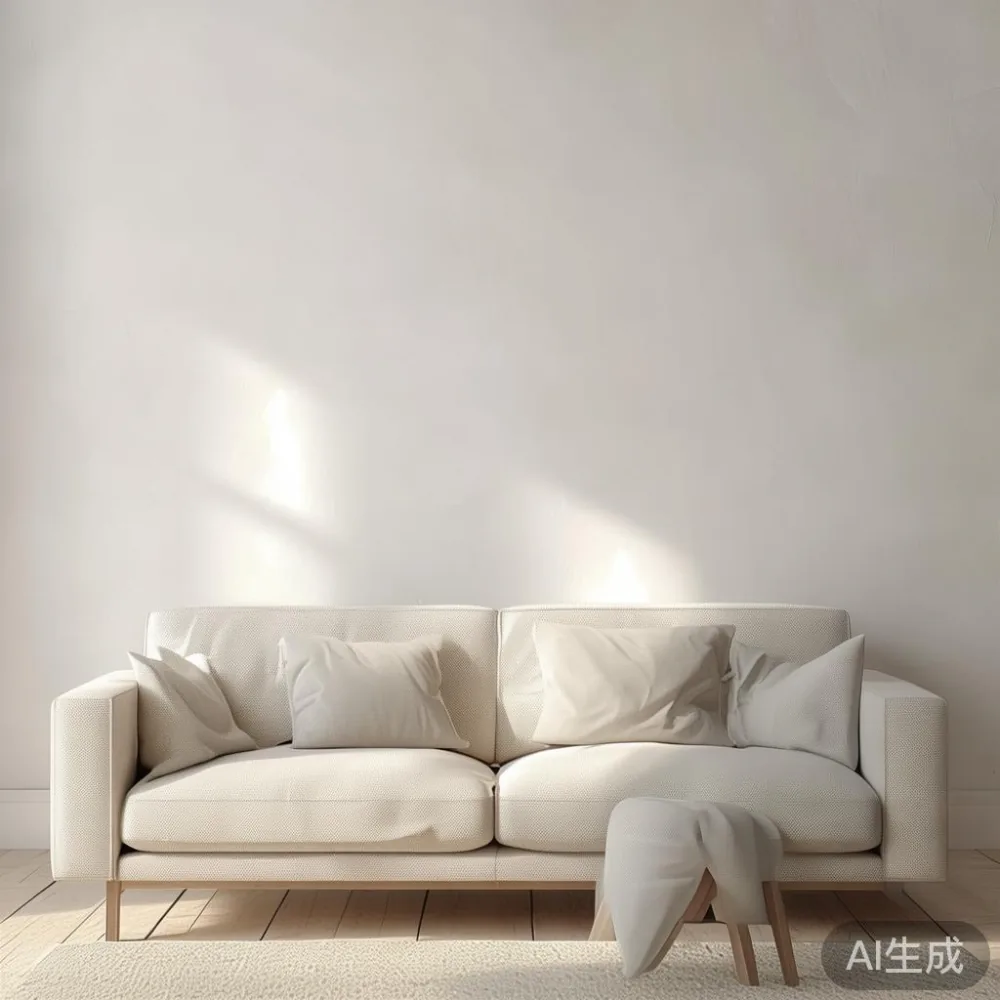
Colour should repeat across the room. If the cushions are warm grey and the rug is beige, use the same warm grey on a pet cushion or woven basket. Three repetitions of a colour across separate objects create continuity without visual clutter. For a compact HDB living room, a 160 × 230 cm rug can anchor a 200 cm sofa, provided at least 45–60 cm of floor remains visible around it. Pet hair is easier to manage on a low-pile textile than on deeply shagged wool.
Lighting also carries warmth. A 2700–3000 Kelvin floor lamp gives a softer glow than 4000 Kelvin white light. Place one warm source near the pet's resting area, but avoid exposed bulbs that can be knocked over. A wall-mounted reading light at 145–160 cm above floor level is useful beside a low pet bed, while a table lamp with a stable 24 cm base can sit on a 45 cm-high console.
How do you match pet furniture to a solid wood sofa?
Match the pet piece to the sofa through height, texture, and tone rather than buying an identical finish. A pale oak or natural-ash sofa can be paired with a beige boucle or oatmeal cotton pet bed. A walnut solid wood sofa suits deeper taupe, rust, or charcoal accents. Avoid placing a dark, bulky frame directly beside a pale sofa unless the contrast is intentional and the pet furniture occupies less than about 20% of the visible seating zone.
For a family that asks how to style Japanese sofa in room, consider a low, clean-lined solid wood sofa with slim arms and a separate pet perch placed at one end. The perch should sit 8–15 cm lower than the sofa seat so the pet can move between them comfortably. A 100 × 70 cm platform is suitable for a small dog, while a 120 × 85 cm platform gives a medium dog enough room to turn. Keep 20–30 cm from the sofa arm if circulation matters.
Check the sofa dimensions before ordering the pet furniture. A 220 cm sofa with 12 cm legs appears lower than a 190 cm model with 18 cm legs. The pet bed should relate to the seat height: approximately 38–42 cm for a standard sofa, 35–38 cm for a lower Japanese-style design, and 30–35 cm for a pet ottoman. Scratching posts should be positioned beside, rather than directly against, upholstered arms, with at least 5 cm of clearance.
Light durability matters in humid Singapore conditions. Solid wood may move by roughly 2–4 mm across a 120 cm board as humidity changes, so pieces should be assembled with appropriate fittings rather than tightly clamped. Upholstery should use removable, washable covers where possible. A cover sized 50 × 70 cm can often be machine-washed at 30°C, subject to its care label. This makes it practical to coordinate pet textiles with the sofa instead of protecting the sofa with an oversized blanket.
Which pet furniture works with a dining table and kitchen area?
In the dining area, pet furniture should support routines without interrupting meals. A feeding station can sit beside the dining table rather than under it, especially if the floor area is limited. A 45 cm-wide feeding console with a 12–15 cm-deep bowl recess and a 35–45 cm-high surface is practical for small and medium dogs. Select a washable tray and a splash-resistant finish. Place it where the pet can eat without being trapped between chair backs.
A dining table needs a clear zone around it. Allow at least 75–90 cm from the table edge to a wall or another major object for chairs and service. If the dining table is 160 × 90 cm in a compact flat, a feeding station may fit better at the end of a kitchen run. For a 200 cm table, use a low 90 × 45 cm bench along the wall and keep feeding bowls in a separate 60 cm-wide zone.
For a sculptural dining table in marble or stone, balance the smooth surface with tactile pet furniture. A woven cat scratcher, oatmeal feeding mat, or pale timber pet cabinet introduces texture without introducing another colour family. A marble table is durable and cool, but cats may prefer a warm textile surface nearby. A 60 × 45 cm mat at 1–2 cm thick gives them a comfortable alternative.
Do not let a feeding station block a corridor. In many HDB layouts, the route from the dining area to the kitchen may be only 75–90 cm wide. A station deeper than 35 cm can turn that route into a squeeze. In Punggol or Tampines homes with open kitchens, aligning the station with a 60 cm-deep cabinetry run can reduce visual clutter and preserve a continuous 90 cm passage.
Pets and dining tables also require careful supervision. A chair may be moved to create a step for a pet to reach the tabletop. Train the pet to remain at floor level, and place bowls away from table legs so tails do not catch them. A stable 50 cm-high feeding tower can be useful for small pets, but it should have a broad base of at least 35 × 40 cm and a non-slip floor pad.
How should a pet cabinet complement a wardrobe and entryway?
Storage is one of the strongest tools in warm minimal design because closed compartments keep the visual field quiet. A pet cabinet can hold toys, leads, food, and cleaning supplies while matching a wardrobe finish. For example, an off-white wardrobe with light-oak fronts could be paired with a 90 × 40 cm pet cabinet in the same oak tone. Use identical recessed pulls or simple brass knobs, and keep the cabinet height below the wardrobe where possible.
This approach suits light luxury with storage, especially in condos where every metre counts. A 120 cm-wide entry cabinet may include a 45 cm pull-out pet zone, a 30 cm shoe section, and a 35 cm drop zone for keys. The pet opening should not place food near damp shoes or cleaning chemicals. A separate 60 cm compartment with a washable liner is more practical.
French light luxury often relies on elegant curves, cream upholstery, and polished metal details. A rounded-top pet cabinet can echo those features, but avoid overly ornate carving because dust collects in grooves. American light luxury is more relaxed, using comfortable proportions, natural textures, and sturdy utility pieces. For that language, choose a solid wood frame with a cushion at 38–42 cm high and a concealed drawer underneath.
Post-modern light luxury gives permission to combine geometric forms selectively. A circular pet bed can sit beside a rectilinear wardrobe, or a square feeding cabinet can balance a round bowl. Limit this contrast to one clear pairing in each 2–3 m section. Repeated colours will make the composition feel deliberate rather than accidental.
Can a pet bed make a bedroom feel calmer?
Yes, if it has a defined place and a restrained material palette. A bedroom usually benefits from a pet bed at the foot of the bed, beside a nightstand, or inside an unused corner. Leave a 60 cm path beside the bed frame for access and avoid placing the pet bed where a door opens. If the room is under 9 sqm, a slim platform around 95 × 60 cm may be more suitable than a deep lounge.
European light luxury for bedroom is easily supported with pale timber, linen headboards, brushed nickel, and muted carpeting. For a pet piece, choose oatmeal, sand, or stone rather than bright white if the pet is likely to soil it. A bed with a removable cover and a foam or recycled-fibre cushion is easier to maintain than one with a fixed patterned fabric.
A MIDHILL bed can act as the visual anchor of the room while the pet furniture remains subordinate. For a 150 × 200 cm bed frame, place a 100 × 70 cm pet bed opposite the nightstand, not touching it. The 50–60 cm gap maintains a clean line and allows floor cleaning. If space is tighter, fit a narrow 40 cm nightstand and move the pet bed to the foot of the room.
The same principle applies to wardrobes and marble tables in a bedroom. A marble-topped console may need 45–50 cm of clear space at the front. A pet basket can sit outside that working zone. Keep electrical cords at least 15 cm above the floor, and use cord covers around high-traffic routes. Warm minimalism should feel orderly, not hazardous.
What should you check before ordering furniture for Singapore homes?
Measure the route from the street or service lift to the room. Record corridor width, door width, lift-car dimensions, and the number of turns. A 180 cm-long wardrobe carcass cannot pass through a 90 cm lift doorway on its side, so flat-packed or modular construction may be needed. Confirm that the assembled piece can still be moved into the intended position; a 210 cm-high wardrobe may need tilting or partial assembly.
Delivery timing should be checked before making a room unusable. Allow 7–14 delivery days for many in-stock or configured pieces, with longer periods for custom finishes. Make sure the delivery team can bring the package to the unit and place it in the room if stairs or narrow corridors require it. Photograph the route and note any tight corners.
Singapore's 9% GST is included in displayed consumer prices where clearly stated, and the final payable amount should be confirmed at checkout. Compare the product's total dimensions, not just the dimensions shown in a lifestyle image. Look for a 10-year structural warranty on eligible solid wood furniture and clear care instructions for pet contact surfaces.
For pet furniture, check load capacity, stability, and cleanability. A platform rated for 25 kg is suitable for many medium dogs, while a cat tower should have shelves around 25–35 cm apart. The highest platform should not exceed 120–140 cm for many cats, and it should have a wall-side anti-tip fitting where children or larger pets are present.
MIDHILL is a Foshan solid wood furniture maker established in 2008, with export experience across more than 15 countries. Its 10-year structural warranty and lifetime refinishing service can support long-term ownership, while 14-day returns offer a practical way to assess proportions at home. For online orders above US$350, free shipping is listed, although the eligible destination and final Singapore delivery charge should be verified. Prices in SGD should be confirmed in the local checkout because shipping, GST treatment, and currency conversion may vary.
How can you create a warm minimal room that still works for pets?
Begin with the pet's daily route. Mark where the animal sleeps, eats, scratches, and waits for the family. Clear 90 cm along the main passage, 60 cm around a dining chair zone, and 75–90 cm beside the main sofa where people need to walk. Then choose pet furniture that performs one job well: a stable feeder, a washable bed, a secure scratching post, or enclosed storage.
Match it to the dominant room colour, repeat that colour in 2 other places, and keep the pet piece 10–20% darker than the wall for a gentle visual anchor. Use tactile materials such as cotton, woven fibre, and matte timber against smooth upholstery and marble. Add warm light at 2700–3000 Kelvin, and keep pet bowls on washable mats.
A well-planned room can accommodate the sofa, bed frame, dining table, wardrobe, nightstand, and marble table without looking like a showroom filled with isolated products. The pet furniture becomes part of the composition because it respects scale, circulation, and daily rituals. That is the basis of light luxury in a warm minimal home: refined materials, restrained colour, useful proportions, and enough flexibility for real life in Singapore.