5-Year Cost Comparison: Veneer vs Solid Wood for Pet Furniture in Singapore
Choosing pet furniture for a Singapore home is rarely a simple matter of matching a photograph to an HDB living room. A dog bed beside a dining table, a cat tree in a Bedok condo, or a low console in a Tampines flat must withstand claws, fur, moisture, cleaning, and daily movement for at least 5 years. Yet the sticker price can be misleading. Veneer may appear economical at checkout, while solid wood asks for a larger initial outlay and can remain useful longer if its finish is maintained.
This comparison follows the true ownership costs of 5 representative pet-furniture pieces over 60 months. Figures use SGD prices, Singapore’s current 9% GST where applicable, and typical delivery windows of 7–14 days for furniture made to order. The calculation excludes fluctuating electricity costs and includes a planned allowance for finish care, replacement hardware, and expected repair work.
For Singapore buyers, delivery is more than a convenience. HDB corridors and common corridors may be narrow, and a sofa or dining table can be difficult to manoeuvre through lift doors, turning angles, and flat entrances. Measurements, packing strategy, and assembly planning can prevent damage before a piece reaches its final room.
What does “5-year cost” mean for pet furniture?
A fair 5-year cost includes more than purchase price and delivery. The model below divides ownership into 7 parts:
1. Purchase price: the item price before GST, including the finish specified for this comparison.
2. GST: 9% on the purchase price.
3. Delivery and carrying: 0–SGD 180 per order for normal access, with an assumed SGD 90 average because a flat lift and corridor are simpler than a landed house with stairs.
4. Assembly: 0–SGD 120 in the first year, depending on the number of components.
5. Finish care: SGD 240 over 5 years for solid wood, including oiling and scratch treatment, compared with SGD 360 for veneer, because edge repair and replacement leaves can be expected more often.
6. Repairs and replacements: 1 probable minor incident in 5 years, budgeted at SGD 180 for either material, plus SGD 90 for one set of fittings in the solid-wood scenario. Veneer receives a larger SGD 150 contingency for delamination or edge repair.
7. Residual value and second life: each piece is assigned a conservative resale value at month 60. Solid wood scores 25% of its purchase price; veneer scores 12%. Pet furniture often changes location before a home move, so this value matters.
The resulting figure is not a resale appraisal. It is a planning number that helps a household compare cash commitments over 60 months.
How much do 5 years of veneer and solid-wood pet furniture cost?
The examples use typical dimensions suited to Singapore interiors: a pet daybed at 100 × 60 × 38 cm, a scratching ramp at 90 × 45 × 70 cm, a feeding station at 120 × 35 × 80 cm, a low storage cabinet at 100 × 40 × 70 cm, and a lounge frame at 110 × 75 × 80 cm. Weight is important because every kilogram adds to the lifting and carrying task.
| Pet-furniture piece | Veneer: price and weight | Solid wood: price and weight | 60-month cost: veneer / solid wood |
|---|---|---|---|
| 100 × 60 × 38 cm pet daybed | SGD 260, 19 kg | SGD 590, 31 kg | SGD 816 / SGD 1,027 |
| 90 × 45 × 70 cm scratching ramp | SGD 310, 24 kg | SGD 690, 43 kg | SGD 932 / SGD 1,136 |
| 120 × 35 × 80 cm feeding station | SGD 380, 27 kg | SGD 760, 46 kg | SGD 1,073 / SGD 1,215 |
| 100 × 40 × 70 cm low storage cabinet | SGD 450, 29 kg | SGD 820, 49 kg | SGD 1,235 / SGD 1,380 |
| 110 × 75 × 80 cm lounge frame | SGD 540, 34 kg | SGD 960, 58 kg | SGD 1,452 / SGD 1,624 |
Across this basket, veneer starts at SGD 1,940 before GST and reaches a 60-month cost of SGD 5,508. Solid wood starts at SGD 3,820 before GST and reaches SGD 6,382. The 5-year difference is SGD 874, or about SGD 175 per year. For a single compact daybed, the difference is SGD 211 over 5 years.
The calculation uses furniture-grade veneer over an engineered board, not a thin decorative skin over particleboard. Low-cost veneer constructions can use less stable cores, while high-grade plywood and hardwood veneers improve resistance to swelling. That distinction affects moisture performance in a humid Singapore environment.
Which material handles claws, spills, and humidity better?
Solid wood offers several advantages in pet furniture. Hardwood sections can be sanded and filled after a claw mark, whereas the face paper of a veneered panel cannot easily be repaired without replacing a leaf. A 3 mm scratch through the veneer may expose a different colour beneath, while a deeper gouge can open the core.
Wood movement is also a factor. Solid timber expands and contracts as relative humidity changes, and a Singapore interior may move between approximately 55% and 75% relative humidity. Skilled makers account for this with stable joinery and finished edges. A well-built veneer panel can be very stable because its thin face moves with its engineered core, which is one reason the material is widely used in dining tables and wardrobes.
Veneer wins in one measurable area: weight. The sample basket weighs 133 kg in veneer and 227 kg in solid wood, a saving of 94 kg. A 31 kg solid-wood daybed is manageable for 2 adults, but a 58 kg lounge frame may require 3 people or professional carrying. Before ordering, measure the lift door at least 90 cm wide, inspect the route from the lobby, and confirm that the largest package is no more than 210 cm long. A 240 cm package may not turn through a 180-degree corridor bend.
Cleaning practices matter more than marketing labels. Wipe urine and water within 10 minutes, keep feeding bowls off the wood, and use a pH-neutral cleaner at a 1:20 dilution. Avoid alcohol, ammonia, and silicone polish on an oiled surface. A pet with a habit of jumping should not be allowed to use an unstable ramp; the ramp in this study should carry up to 35 kg.
Is the extra spend on solid wood justified?
The answer depends on the household’s priorities, not merely the furniture category. A low-cost veneer pet bed may be a sensible choice for a rental flat, a temporary arrangement, or a pet that spends most of its time indoors. If the item will be moved through a Punggol HDB lift every year, its lighter weight may have more practical value than a repairable timber edge.
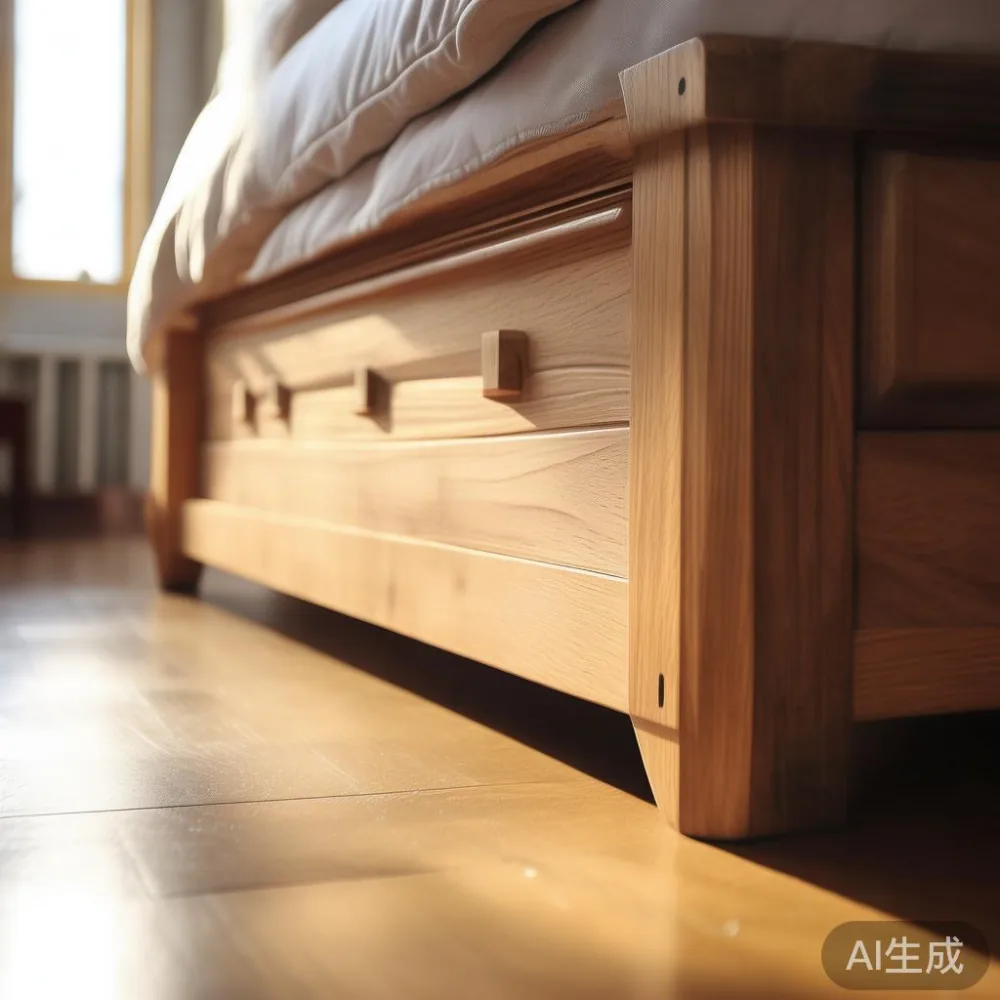
Solid wood becomes easier to justify when a piece performs several jobs. A solid wood sofa may anchor a living room, a solid wood bed frame may contain a pet bed beneath it, and a dining table may support a feeding station at one end. A wardrobe can include a ventilated pet alcove, while a nightstand can hold bowls and a washable mat. These broad functions connect pet furniture to the rest of a home rather than treating the pet corner as an isolated object.
This is also where French light luxury and American light luxury styles meet the material question. Pale oak, walnut-toned timber, tapered profiles, and restrained storage can give a condo a polished French light luxury mood without making every surface decorative. For a family comparing an European light luxury bed vs Nordic bed, the pet zone may need a washable timber platform rather than loose fabric.
Conversely, if the broader room follows designer Mid-century modern furniture, tapered solid-wood pet furniture can coordinate with slim legs and clean lines. The comparison between an American bed vs Mid-century modern bed is partly about proportion, but pet safety still depends on clearance, stability, and surface finish.
How do delivery, assembly, and warranty change the calculation?
A quoted furniture price is not the delivered price. The model includes an average of SGD 90 for delivery and carrying, but a difficult access route can add SGD 60–SGD 120. Standard Singapore delivery commonly takes 7–14 days after production. A made-to-order piece may take 21–35 days, especially during a year-end period. Allow 4–6 weeks before placing a pet-feeding station around a household move.
MIDHILL gives a 10-year structural warranty and a lifetime refinishing policy on qualifying products. Warranty documents should be checked for exclusions such as finish damage from spills, claws, or misuse. Structural coverage can reduce the expected cost of joint failure, while refinishing can preserve appearance after years of use. Neither replaces sensible care: a chewed corner is not the same as a structural defect.
For 2 people, budget roughly 15 minutes to unpack and assemble a light daybed and 45–75 minutes for a feeding station. Add SGD 120 for professional assembly if the route includes a narrow corridor and no trolley. Confirm the package count before the driver arrives. A 5-box shipment may need 20 minutes just to stage near the lift.
Some customers ask whether an is Italian light luxury sofa worth it in a compact HDB living room. The design name does not decide the value; dimensions, comfort, frame warranty, and material repairability do. A 180–200 cm solid wood sofa may be suitable for a larger condo, but a 150 cm version may preserve a 70 cm passage more effectively. A protected floor path and a non-slip rug can prevent a pet from sliding into the frame.
What should a buyer in Tampines, Bedok, or Punggol consider?
Singapore’s local context changes the cost of ownership. GST adds 9%, while a free-shipping threshold of US$350, approximately SGD 470 at an indicative exchange rate of 1.35, does not automatically apply to every local order because promotional terms can differ. Confirm the Singapore delivery quote before payment. A 14-day return window provides useful protection, but a used pet item may not qualify if it has been scratched, so inspect it indoors before allowing pets access.
HDB layouts reward compact planning. A feeding station no deeper than 35 cm can fit against a dining wall while leaving 75 cm of walkway. A low cabinet at 70 cm high may suit a Bedok family room better than a tall unit. In Punggol, where many new flats have narrow corridors, check whether the carton fits the lift car diagonally; a 160 × 45 × 40 cm package can occupy more usable floor space than its dimensions suggest.
The phrase French for dining room can describe a pet-friendly arrangement in which bowls sit beside the family dining table rather than in the kitchen. Keep the feeding zone at least 1 metre from a hot dish and place a washable, non-slip mat under a raised bowl. For a marble table, use a separate timber feeding pedestal: acidic food and water can etch marble, and the combined weight may complicate moving.
A MIDHILL wardrobe can be evaluated on the same practical basis as pet furniture. Confirm internal dimensions, shelf spacing, and whether a ventilated section can accommodate a pet bed. Wardrobe doors need smooth, pet-safe closing; magnetic catches can trap paws, so a soft or recessed latch is preferable.
How do I choose between veneer and solid wood for my pet?
Choose veneer when the priority is a controlled budget, frequent relocation, or a lightly used piece. Choose solid wood when claws are likely, the furniture performs more than one function, or the household plans to keep it beyond 5 years. The modelled difference is SGD 874 across 5 items, but 1 well-used solid-wood cabinet may cost only SGD 145 more over 5 years than its veneer equivalent. That is a reasonable monthly amount for a piece intended to remain in a family home.
Ask the seller for 4 facts before paying: the exact veneer core, the solid-wood species, the finish thickness, and the warranty exclusions. “Solid wood” alone does not specify construction, so confirm that legs, rails, panels, and frame components are timber where expected. For a pet lounge, require a stable base, a load rating of at least 40 kg, rounded edges of 2–3 mm, and a finish that can be renewed locally.
Measure the home before the furniture. Record the lift width, the narrowest corridor, the doorway, and the turning space at the stair landing. Allow at least 60 cm for a main passage and check that a pet cannot be trapped behind a sofa or wardrobe door. These small checks can prevent SGD 200–SGD 600 in wall repair, floor scratches, or a failed delivery attempt.
After delivery, photograph the joints, finish, and packaging before assembly. Test stability with 10 kg for 1 hour, then increase the load gradually. Clean spills within 10 minutes and inspect claw marks every 3 months. Re-oil solid wood every 6–12 months, depending on use, and keep the pet bed away from direct afternoon sun.
Over 60 months, veneer is the lower-cost option in this model, while solid wood creates more flexibility for repair, refinishing, and multi-purpose use. For Singapore pet furniture, the soundest purchase is the one that fits the lift, suits the room, and can be maintained without replacing the entire piece after one mishap.