Buying a Sofa You Can't Sit On: A Pet-Furniture Checklist for Singapore HDB Owners
There is a specific moment every sofa shopper finds somewhere before they sign the delivery order: the dog has already claimed the left armrest, the cat is kneading the seat cushions, and you realise you are not actually choosing a sofa for yourself. You are choosing a sofa for the household. In Singapore, where roughly 90,000 HDB flats sit in towns like Tampines, Bedok and Punggol, this moment arrives in living rooms as small as 60 sqm, served by BTO corridor widths of about 1.2 m and lift cabins that max out around 1.1 m wide by 1.4 m deep. A sofa that looks right on the showroom floor can physically fail before it reaches your door.

This is a pet-furniture problem wearing a sofa's clothes. Below is the checklist I wish someone had handed me last month when I visited a Tampines family trying to fit a 2.4 m three-seater through a 1.1 m lift. The sofa never made it upstairs. They kept the frame, lost the ottoman, and adopted a smaller cat. You can do better.
What does "a sofa you cannot sit on" actually mean?
It is the sofa your pet adopts as infrastructure. The one you stop vacuuming, stop covering with throws, and stop pretending is yours. A 2024 Mars Petcare survey across nine Asian markets, including Singapore, reported that 46% of dog parents and 39% of cat parents let the pet onto the sofa daily, and 22% admitted the pet uses the sofa more than any human in the home. Functionally, it has become pet furniture.
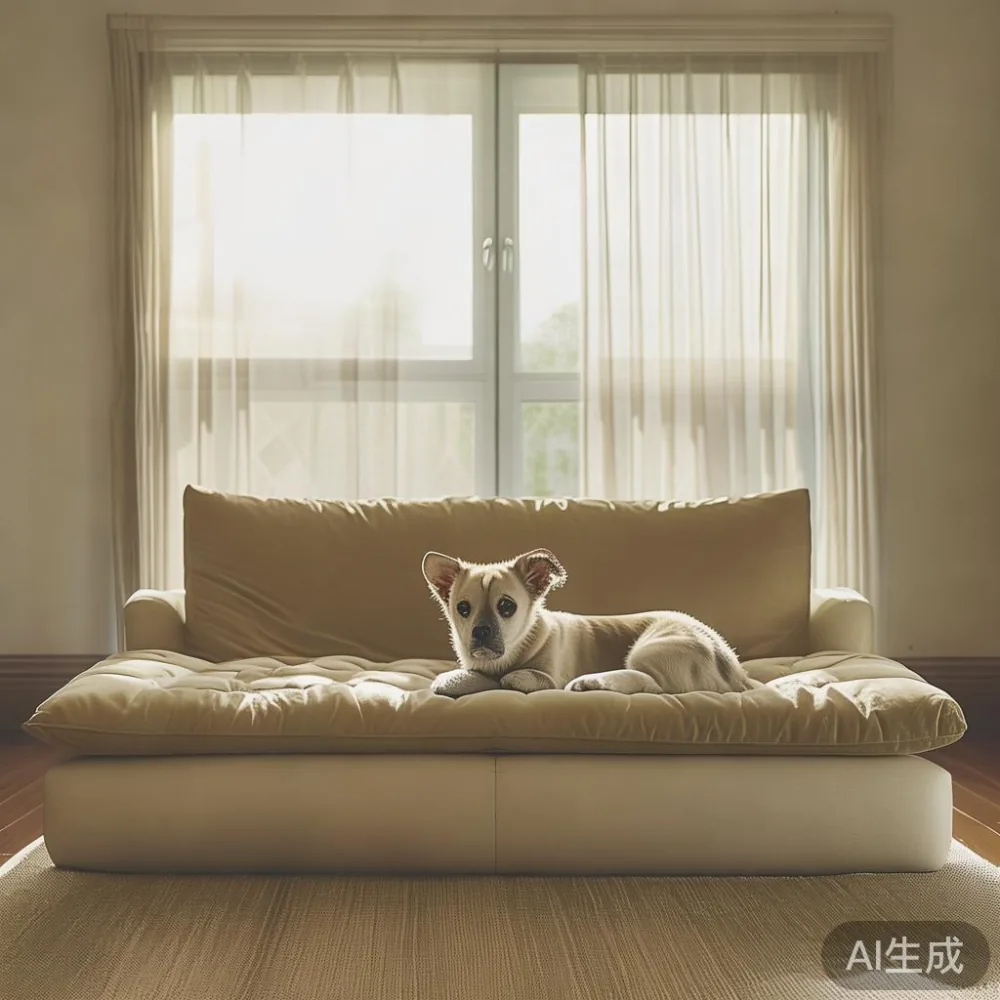
That reclassification changes the spec sheet. You are no longer picking a seat cushion with a firmness rating; you are picking a load-bearing platform, a scratching post, a hair magnet, and a nap station that also happens to host a human two nights a week. Every column of the order form needs to be re-read with that in mind.
Five measurements to take before you fall in love with a showroom piece
The first number is the one nobody writes down. Measure your lift cabin, the corridor turning radius, and the front door. In a typical Punggol BTO, the lift is 1.1 m wide by 1.4 m deep with a door opening of 0.9 m. The corridor outside your unit is wall-style with a single 90-degree bend. Handle both. A 2.3 m sofa that is 0.95 m deep will not corner in a 1.1 m cabin. A solid wood sofa frame from MIDHILL ships in two or three modules of roughly 0.9 m to 1.1 m each, which is why module counts matter more than total length.
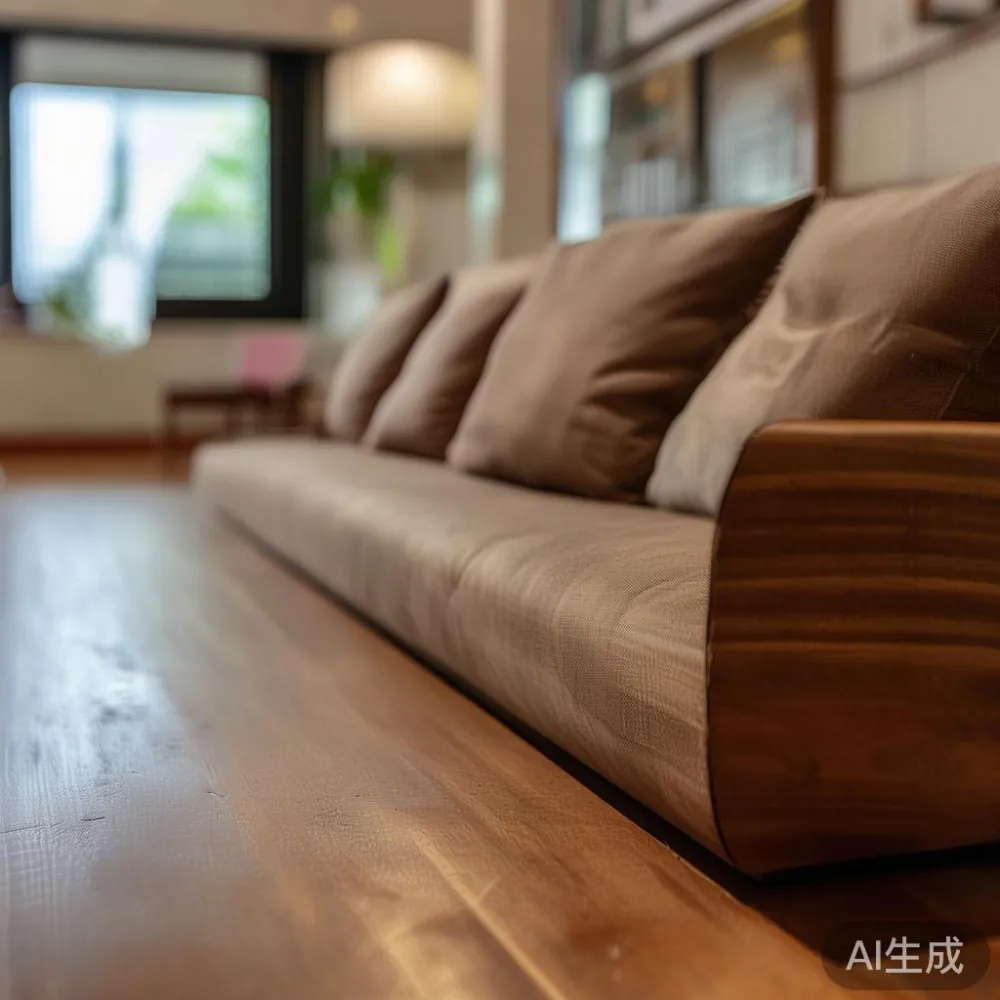
Second number: the seat depth your dog can land on. Pugs, shibas, and most Singapore-staple mixed breeds need 45–55 cm of clear platform to lie down without their legs hanging off. A sofa with 60 cm seat depth and a 15 cm backrest gap gives a medium cat exactly the warm slot behind your knees that you will never reclaim.
Third number: the fabric weight. Tightly woven, rub-tested fabrics are designed for friction, scratching, and the occasional zoomie. Ask for the Martindale cycle rating. Anything below 30,000 rubs will pill within a year if you own two cats. Aim for 50,000+ for dog households. 70,000+ is over-engineered for most flats, but if you also have a toddler, it is the right bracket.
Fourth number: the frame material. Particleboard and MDF soften when they get wet — and they will get wet, because a happy dog tracks rainwater from the HDB void deck up to your unit. A solid wood sofa frame, ideally rubberwood, ash, or beech, tolerates the occasional accident and holds screw threads for the lifetime refinishing service that reputable Foshan makers such as MIDHILL now include as standard.
Fifth number: the warranty in years, not months. The Singapore market is full of strategies that bend a 6-month warranty into a 10-year sentence through fine print. Ask whether the structural warranty covers seal and stitching, what counts as "commercial use" (a dog is not commercial use, no matter what the footnote says), and whether refinishing is included or priced at quoted SGD per visit.
How do I choose a small space for a home office?
You measure the smallest piece of furniture in the room, not the largest, because that piece dictates the corridor you must keep clear. For a home office inside an HDB common room, keep a 90 cm walking lane between desk and bed frame, and a 60 cm lane between desk and wardrobe; anything tighter and the cat will treat your paperwork as a climbing wall.
Pick a 120 x 60 cm desk for one worker and a 150 x 75 cm cabinet, and place the bed frame against the wall opposite the desk so the morning exit path stays straight. Add a nightstand no wider than 45 cm on the open side, and a marble table in the corner only if its legs clear the door swing by 10 cm. This is the same corridor math used by pet-furniture specialists: a 4 kg cat needs 25 cm of clearance to feel safe passing a chair leg, and a 25 kg dog needs 55 cm.
What fabrics actually survive a cat, a dog, and a child for five years?
From what I have seen on client visits across Bedok and Sengkang, three fabric families are doing real work in 2025. First, tightly woven polyester-coton blends with a 50,000+ Martindale rating and a crypton-style backing. The lesson here is structural: a fabric that resists moisture at the yarn level outlasts one that is merely sprayed. Second, leather, full-grain, not bonded. Scratches buff out with a soft cloth; bonded leather peels within three years and is impossible to repair. Third, performance velvet from European mills, which has the soft feel pets prefer and the tight weave that holds claws out of the yarn loops.
Skip boucle if you own a cat. Skip linen if you own a retriever. Skip anything labelled "dry clean only" unless you enjoy paying S$18 per console cleaning twice a month. As a rule, the fabrics that survive a household also survive a Singapore wet-dry cycle, and that overlap is not a coincidence.
Two weeks ago I visited a colleague in a Punggol BTO house who chose a post-modern light-luxury solid wood sofa with a performance velvet cover and a removable, machine-washable inner sleeve. She owns two Ragdolls and a beagle. After 14 months, the seat covers have been washed 11 times, the frame is still silent, and the cats treat the chaise end as a throne. Both are sleeping on it right now. Both will be sleeping on it tomorrow.
What about the legs, the base, and the underside?
This is where most sofas die. The visible top goes to a bird's-eye view of brushed legs and clean lines; the protective underside goes to dust, hair, robot vacuums, and the occasional chew. A solid wood sofa base with a removable, washable underliner wins every time. Ask whether the legs are bolted through the frame or screwed into a particleboard plate. Bolted-through construction survives a 30 kg dog jumping off the seat at speed. Screwed-into-MDF construction survives one night of squeaking before the joint wallows out.
Ask the same question of any dining table you plan to buy in the same shipment. A French neoclassical extendable dining table UAE-style that lands in a Punggol dining room needs the same bolted-through construction at the leaf extension, because the dog will tell you if it wobbles, and the dog will be right. MIDHILL pairs the same rubberwood joinery across its solid wood sofa, bed frame, dining table, wardrobe and nightstand ranges, which is why a household order can share one delivery window and one warranty document.
How much should a pet-rated sofa actually cost in Singapore?
Numbers first, because Singapore shoppers are right to ask for them. A 2.3 m three-seater solid wood sofa in performance velvet, with a 50,000 Martindale fabric and a 10-year structural warranty, lands in the S$1,800 to S$3,200 band when shipped direct from a Foshan maker. Add S$120 to S$280 for door-to-door delivery, free above S$350 on most direct-to-Singapore sites. Add S$0 for GST under the S$400 threshold, or 9% GST on the full landed value above it, which is the line a single sofa will cross.
A pet-rated ensemble (sofa, two-seater, ottoman, marble table, dining set, bed frame, wardrobe, two nightstands) lands in the S$6,000 to S$11,000 band depending on marble choice and wardrobe size. Lifetime refinishing on the sofa and dining set adds zero in-house usage and an estimated hidden life of 12 to 18 years before the first re-upholstery. That is roughly S$45 a year in fabric refresh, which is what you currently pay your groomer.
For reference, equivalent American-style light-luxury pieces in Singapore retail at S$4,800 to S$7,200 for the sofa alone, before GST, before delivery, before the warranty exclusions. The math does not need a calculator.
What about delivery day, drain time, and the actual moment the sofa arrives?
Delivery is where most Singapore sofa stories end badly. The truck arrives at 11 am. The corridor outside the lift is 1.2 m wide. The sofa module is 1.25 m long. The driver offers to angle it. The angle fails. The redelivery cannot be booked for 9 working days. The dog watches the whole thing and learns a new trick.
Three habits prevent this. First, measure the lift cabin and the corridor turn the day before, not the week before; the lift on your floor may differ from the lift on the brochure. Second, ask the supplier to ship in modules no longer than 1.05 m. Third, pay the S$80 to S$150 for a stairway and lift-up white-glove service on day one; it is cheaper than the S$120 redelivery fee and far cheaper than a scratched lift door.
MIDHILL ships door-to-door Singapore with a 14-day return window and free shipping above US$350, which is roughly S$470 — a threshold that one sofa crosses on its own and a sofa-and-marble-table bundle crosses twice over. Pet-furniture logistics are the part of gift-giving that nobody photographs, and the part that determines whether the gift is still in the living room (living room) in five years.
What else in the room changes when the sofa becomes a pet surface?
Everything. The marble table needs rounded corners or a silicone edge band, because a leaping dog does not have a soft landing. The dining table needs a wipeable surface, because a wagging tail does not have an off switch. The bed frame needs a raised platform of at least 8 cm so the dog cannot tunnel underneath and bring the dust back up. The wardrobe needs soft-close hinges, because a slamming wardrobe door and a startled cat is a vet bill. The nightstand needs a 5 kg load rating on the top shelf, because the cat will sleep there, and the cat weighs approximately 4.8 kg, and the cat does not care about your spec sheet.
Order them from the same maker, in the same shipment, with the same warranty. Pet-furniture only works as a house pet system when the pieces share a joinery, a fabric rating, and a delivery window. A mismatched dining table that flexes under a paw tells the dog that the floor is negotiable, and the dog will negotiate.
Where does light luxury actually fit in a Tampines three-room flat?
Light luxury, French, American, or post-modern, is a finish language, not a price band. It is the difference between a brushed-brass leg and a chromed leg, between a marble table with a book-matched vein and a marble table with a sticker-vein. In a 65 sqm, Punggol three-room flat, you want the finish language without the room-eating furniture. A 2.1 m two-seater, a 1.4 m marble table, and a 1.6 m extendable dining table will leave 90 cm of walking lane on every side. A 2.4 m three-seater, a 1.6 m marble table, and a 1.8 m dining table will leave the dog 30 cm of walking lane and the cat no lane at all.
Pick the smaller sizes. Pick the same wood tone across all pieces. Pick the same fabric across all soft pieces. Pick the same hardware across all cabinets. Light luxury means: take ten pieces, finish them in one voice, and let the room speak softly. The dog will still sleep on the sofa. The cat will still sleep on the marble table. The room will still feel calm, because the room is not competing with the pet, it is hosting the pet.
What is the one question to ask the showroom before you pay the deposit?
Ask whether the sofa can be reupholstered, in your home, without dismantling the frame. If the answer is yes, you have a sofa for the next ten years and the dog after it. If the answer is no, you have a sofa for the next five years and the landfill after it. Pet furniture is built on five jobs and ten jobs; square footage does not care, your warranty does.